

Blog

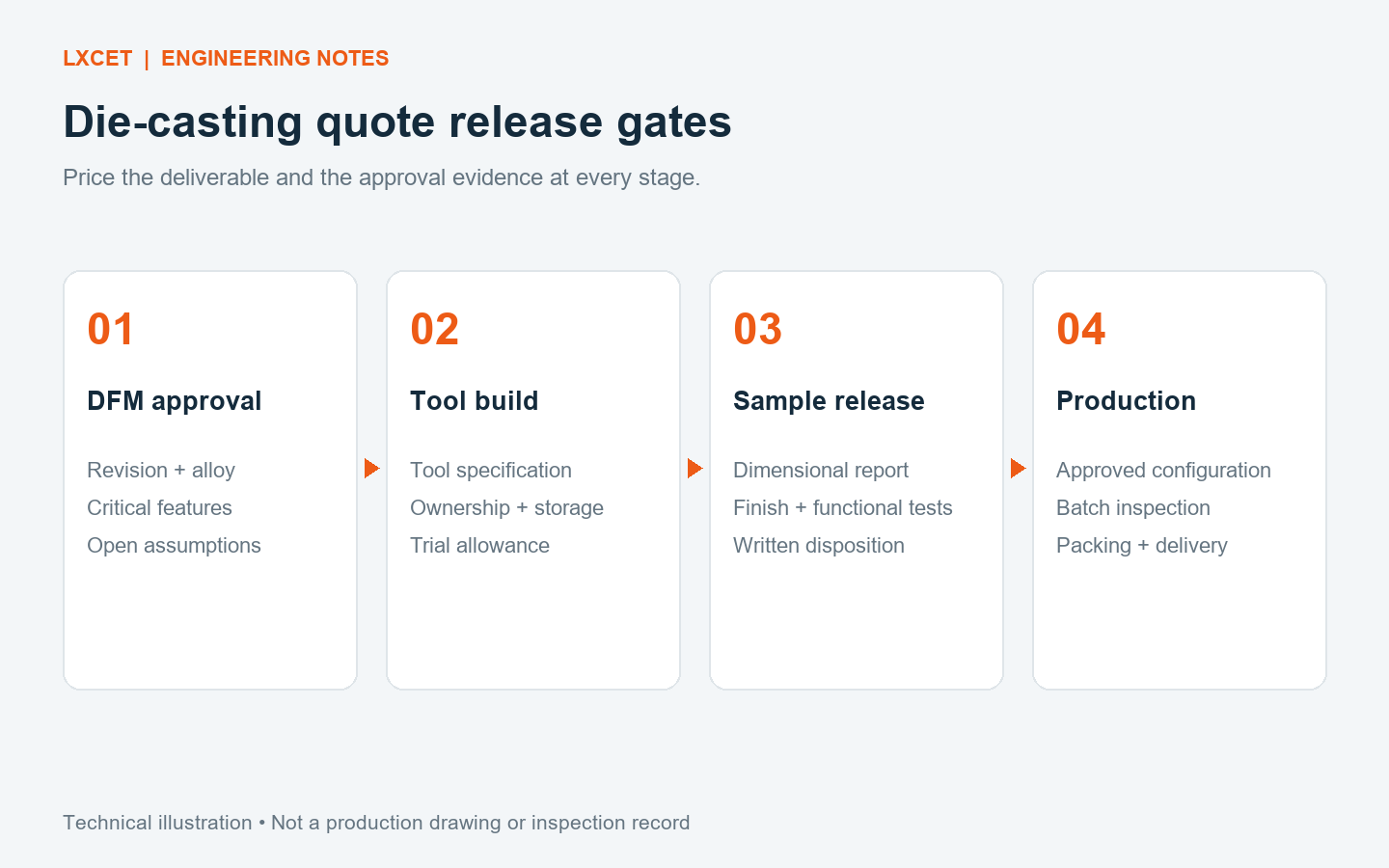
Two suppliers quote the same aluminum housing. One includes tooling trials, machined sealing faces and a sample report. The other lists a mold price and an as-cast unit price. The totals look comparable until the first trial exposes work that was never included. A die casting tooling quote checklist should make the deliverables, approval stages and repeat-order assumptions visible before a purchase order is issued.
Define the delivered housing before pricing the mold
High-pressure die casting forms parts using a dedicated metal die. Critical interfaces may need secondary machining. Xometry’s published process describes DFM approval before tooling and sample approval before production. Those are useful reference stages for structuring a buyer’s enquiry; its commercial terms and capacities do not establish LXCET’s services or commitments. Source: Xometry, die-casting process overview.
Issue one quotation package with a revision-controlled drawing, CAD model, alloy specification and quantity schedule. Identify surfaces that must seal, locate bearings, carry threads or meet cosmetic requirements. Ask each supplier to return the same scope sheet with exceptions marked, rather than comparing free-form offers line by line.
Die casting tooling quote checklist: compare these cost boundaries
| Quote line | Ask the supplier to state | Decision it supports |
|---|---|---|
| Tool build | Tool specification, cavity count, included inserts and approved part revision. | Whether offers describe the same tooling deliverable. |
| Trials and corrections | Included trial rounds, sample quantities and how changes are classified. | Which work is covered before sample approval. |
| Secondary machining | Features, datums, machining allowances and any fixture charges. | Whether the unit price reaches the finished drawing. |
| Finish and inspection | Finish scope, test method, report coverage and outsourced work. | Whether acceptance evidence is included. |
| Repeat orders | Order quantity, setup fees, maintenance assumptions and quote validity. | Whether future orders retain the same cost basis. |
| Delivery | Packing, delivery terms, destination and excluded charges. | Whether the landed-cost comparison has the same boundaries. |
Specify mold ownership, storage and transfer separately
Payment for tooling should not leave its identification and handling arrangements unclear. Ask the quotation to name the tool, identify where it is held and explain who authorizes its use. Request written ownership, maintenance, storage and transfer terms appropriate to the project; obtain commercial or legal review where needed.
For context, Xometry publishes customer ownership together with supplier storage and separate retention conditions. That illustrates why an ownership statement alone does not describe the complete arrangement. Do not assume another supplier uses the same policy. Source: Xometry, tool ownership policy.
Clarify what would accompany a transfer: the identified tool, relevant drawings, maintenance records and any separately purchased fixtures. Ask about transport responsibility and compatibility review. A tool changing location should trigger a planned requalification rather than an assumption that production can restart unchanged.
Request a tooling schedule with release gates
A single number of weeks is ambiguous if one supplier means first trial and another means approved production samples. Ask for dated milestones for DFM approval, design freeze, tool completion, first trial, report delivery, corrections and sample disposition. State which customer approvals or purchased items start each clock.
Illustrative commercial comparison: suppose Offer A lists a $12,000 tool and $8 finished-part price, while Offer B lists a $10,000 tool, $8 casting price and $3 secondary machining charge. At 1,000 accepted pieces, the stated subtotal is $20,000 for A and $21,000 for B before any other charges. These are invented teaching figures, not supplier quotations, market benchmarks or LXCET prices. The calculation is valid only after the delivery and acceptance scope match.
Make sample approval evidence explicit
Attach the required report characteristics to the RFQ. For a sealing housing, specify the actual leak-test method, limits and configuration if a test is required; the phrase “leak tested” does not identify a pass condition. For cosmetic faces, agree viewing conditions and an approval reference. Identify material documentation and any traceability required for the sample and later batches.
Record deviations individually. An approved sample with a temporary concession should not become permission to change the production drawing. Separate approval to proceed with corrections from approval to manufacture the production quantity.
Before issuing the purchase order
- Confirm the same part revision, alloy, quantities and finished condition in every offer.
- Resolve exclusions for tooling, trials, machining, finish, reports and shipment.
- Record ownership, storage, maintenance and transfer terms.
- Define the meaning of each lead-time milestone and its dependencies.
- Set sample acceptance evidence and the written production-release point.
- Agree how engineering changes and repeat orders are requoted.
Send a scope that engineering and purchasing can both approve
See the die-casting project review, inspection report checklist and material traceability guide. Email your requirements to tonyzhou@lxcet.com. A project-specific quotation must confirm the production route, tooling schedule and documentation scope.