
Aluminum 6061 vs 7075 for CNC Machined Parts: Strength, Cost, Corrosion and When Each Wins

0
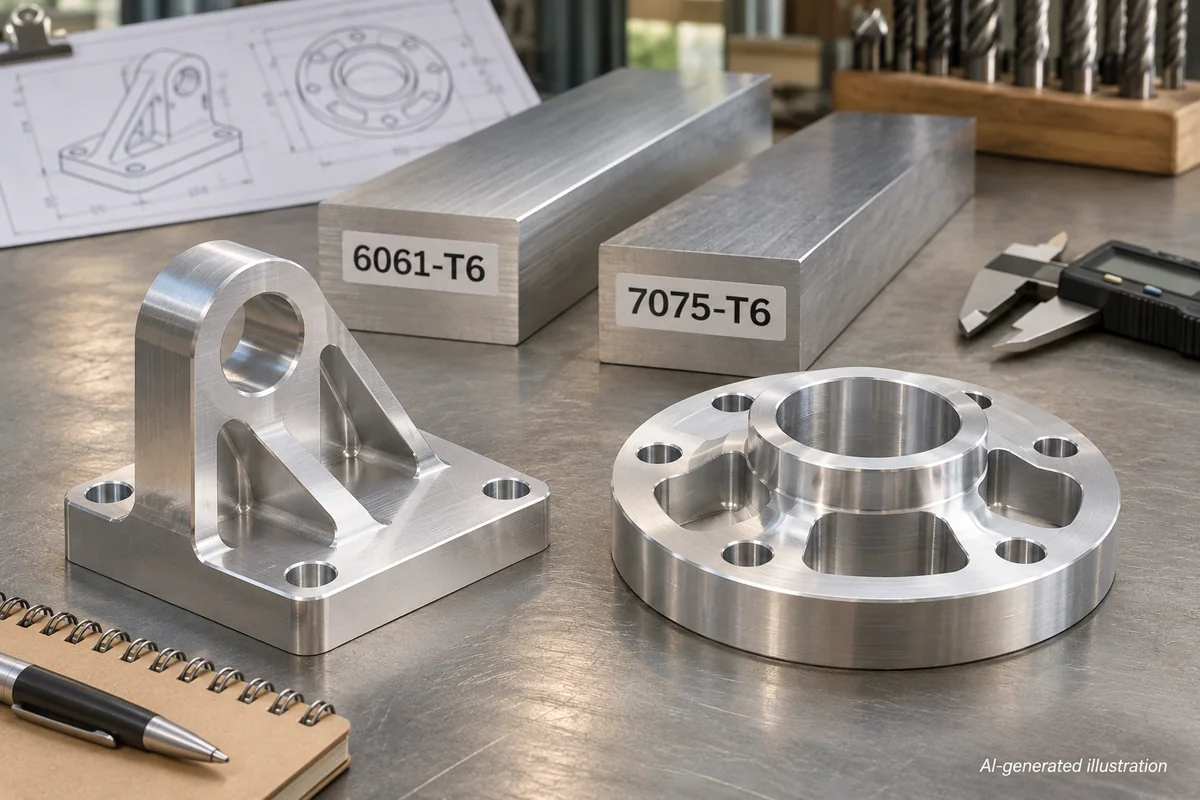
AI-generated illustration of Aluminum 6061 vs 7075 for CNC Parts

“Can we make it in 6061 instead of 7075?” and its mirror image, “should this be 7075?” are the two most common material questions in custom CNC work. Both are excellent machining aluminums, and both are frequently specified for the wrong reasons: 7075 because it sounds stronger, 6061 because it is cheaper. The right answer depends on what the part carries, where it lives, and how it is finished.

This comparison covers the differences that matter in machined parts, not just the datasheet rows: strength where it counts, machinability, corrosion behavior, finishing, and the failure modes each alloy brings with it.

The strength difference, in practical terms

On paper, 7075-T6 offers roughly 1.7 times the yield strength of 6061-T6 (about 500 MPa versus 270 MPa). In real parts this translates less directly than the numbers suggest, because most aluminum part failures start at stiffness or fatigue, not ultimate strength. 7075’s higher strength lets a section be thinner for the same load, which is why it earns its place on weight-critical parts: aircraft fittings, UAV link arms, high-load brackets and clamping features that see repeated peak loads.

For enclosures, housings, plates and brackets under steady loads, 6061 reaches the same functional stiffness at similar weight, because stiffness is set by elastic modulus, and the two alloys are essentially identical there (about 69 GPa both). Paying 7075 prices for a battery enclosure buys almost nothing.

Machinability and cost

6061 is more forgiving in the shop: it chips cleanly, distorts less during heavy stock removal, and tolerates aggressive roughing without drama. 7075 machines well too, but high-zinc alloys are more sensitive to residual stress, and large pockets in 7075 plate are more likely to move between roughing and finishing. Both factors show up in price and lead time, and 7075 raw stock typically costs 1.5 to 2.5 times the 6061 equivalent.

One detail worth knowing: stress-relieved tempers matter more in 7075 than in 6061. For thin-walled or heavily pocketed 7075 parts, T7351 (stress-relieved plate) behaves far better than standard T6, and we specify it by default for that geometry.

Corrosion and finishing behavior

This is where 6061 quietly wins more often than datasheets suggest. 6061 anodizes evenly and takes a clean, uniform Type II or Type III finish. 7075 contains more copper, which anodizes to a slightly yellower tone with more visible grain variation, and its corrosion resistance in salt environments is measurably lower unless properly sealed. For marine-adjacent or wash-down service, 6061 with a good anodic film usually outlasts 7075 with the same finish.

For either alloy, the finishing step interacts with fits: anodic coatings add thickness to every exposed surface, which is why anodizing dimensional change needs to be planned before the bore is machined, and why parts that need bare corrosion resistance are often better switched to stainless than to a higher-strength aluminum.

Where each alloy wins

Choose 7075 when

  • The part carries high or reversing loads in a weight-limited envelope: control links, structural fittings, fixtures under clamp shock.
  • Thin sections must survive impact or fatigue, such as drone frame components and arm hard points.
  • The design alternates between aluminum and steel versions and the aluminum must approach steel strength.

Choose 6061 when

  • The part is an enclosure, plate, or bracket where stiffness and cost dominate, such as guide shaft support brackets and housings.
  • Thermal conduction matters: 6061 spreads heat slightly better and is the default for cooled plates and electronics housings.
  • The part will be welded, since 7075 is effectively unweldable for structural use.
  • Corrosion exposure is significant and a uniform anodic film is the main defense.

Two mistakes we see on incoming drawings

The first is specifying 7075 across an entire part because one corner carries load. The better structure is 6061 with a local insert, or a redesign that thickens the load path, usually cheaper than an all-7075 part. The second is specifying T6 for a heavily pocketed thin-wall part; the stress relief of T7351, or a roughing sequence with rest periods as described in our thin-wall machining guide, prevents the warpage that shows up at final inspection.

The broader selection logic across metals and plastics is covered in the materials selection guide.

What this looks like in practice

LXCET machines both alloys daily from certified plate and bar, with material certificates available per order, and we flag drawings where the alloy looks mismatched to the load case before quoting rather than after delivery. If you send the part’s load case, environment and finishing plan, we will recommend the alloy and temper, state it in the quote with the reasoning, and let you compare that offer against alternatives on equal terms.

Browse machining capabilities or send your drawing for a material review.

Leave a Reply

Your email address will not be published. Required fields are marked *